Chris Miller looks into issues surrounding the nuclear weapons debate and whether we should talk about "disarmament" or "abolition."


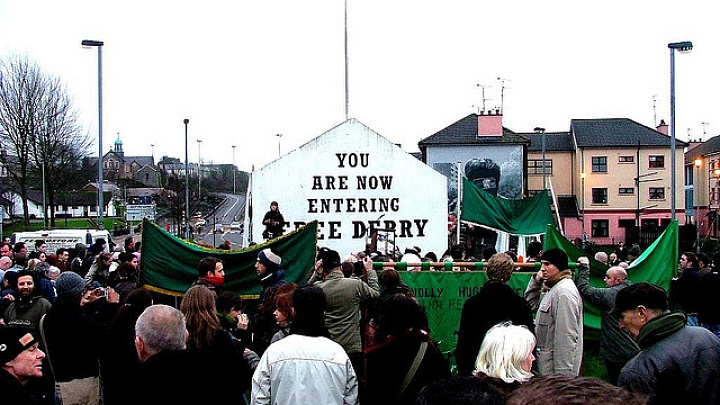
The Troubles in Northern Ireland are often neglected as an example of a largely successful counterinsurgency operation, possibly due to its generally low level of violence in comparison to other COIN operations across the world. Despite a problematic start, the process of “criminalization” of IRA terrorist violence may provide a new light on COIN doctrine in 21st century sectarian and ethnic based conflicts.
The Initial Phase: Policing to Counterinsurgency: 1969-1976
During the initial phase from 1969 to 1976, the single Army Brigade stationed in Northern Ireland was called in to assist the civilian authorities following mass rioting after the Protestant marching season of 12 July to 14 August 1969. After days of sustained and widespread rioting that saw the creation of barricaded ‘no go areas’ in the Bogside of Londonderry, the Royal Ulster Constabulary (RUC), a largely Protestant force, felt it could not control the riots, and formally requested Army assistance. Troops were deployed into Belfast on 15 August.
During this initial phase the role of the Army was to supplement the police in restoring order to Northern Ireland, rather than counterinsurgency operations. This largely required them to stand between the Protestant and Catholic groups on what was known as the ‘Peace Line’ to prevent open brawling and combat in the streets, and to guard public buildings after arson and bomb attacks. They initially had a ‘honeymoon’ period of support from the local population, because the Army was seen as neutral in the sectarian violence in a way that the protestant-dominated RUC was not. With the rioting quelled, the Army, as in previous times of civil disorder during the 1940s and 1956-62 disturbances, started to disengage from operations in Northern Ireland.
However, from autumn 1969 into summer 1970 the IRA reorganized, splitting into the “official” and “provisional” wings (PIRA), the latter deciding to pursue a terrorist campaign against the Protestant government and the Army. The terrorist campaign started in April 1970 when the PIRA attacked protestant areas of Belfast. These attacks continued into the summer.
In response the Army deployed classic counter-insurgency techniques, the net effect of which was that the Catholic community began to slowly turn against the Army. It imposed a curfew on the Catholic Falls Road area of Belfast. This was further exacerbated by large-scale house search operations by the Army to remove weapons and explosives from Catholic areas. Internment without trial began in 1971 for suspected members of the IRA. However much of the intelligence regarding these suspects was significantly out of date and many were interned without cause.
The Army was deployed as an aid to policing, a role it was not trained for…allegations of harsh treatment created greater alienation of the Catholic population than the tactical importance of the information gained.
This period also saw the increasing sophistication of Army tactics in combating the PIRA. Initial patrols in platoon strength, through the towns and countryside were altered to a policy of smaller 4-man ‘bricks’ patrolling simultaneously along parallel streets, creating ‘nets’ that could more effectively respond to any terrorist shooting incidents to capture the suspect and close their line of retreat. Smaller units were less threatening to locals and thus enabled the development of a closer relationship and easier collection of intelligence information. Random vehicle checkpoints manned by the Army grew increasingly sophisticated as the data on vehicle movements were collated by computer for the first time to identify possible suspects and their movements. The RUC began the process of reform during this period with the disbandment of the B-Specials and dismissal of those officers with links to the growing Protestant paramilitary organisations such as the Ulster Volunteer Force and the Ulster Defence Association, who were active in tit-for-tat violence against the Catholic population increasingly from 1972.
In sum, the Army was deployed as an aid to policing, a role it was not trained for. It lacked solid intelligence to effectively perform the role. Following an initial honeymoon period, the Catholic community began to lose confidence in them as they had the RUC police force. The Army began to employ counterinsurgency techniques in the face of rising violence. By the end of 1972 there were 22,000 soldiers deployed to Northern Ireland. Soldiers arrested suspects extra-judicially and were not given police powers of arrest under legal warrants until the mid-1970’s creating a problem with the legitimacy of their actions among locals. While interrogations of interned suspects resulted in significant intelligence, allegations of harsh treatment created greater alienation of the Catholic population than the tactical importance of the information gained. This was also the case with the seizures of weapons in wide-scale house to house searches, and the imposition of curfews. The result was a significant hardening of Catholic opinion towards the British as it was felt their community was being held collectively responsible and the Army was the tool of the Protestant Stormont Government.
Phase Two: Criminalization: 1974-1995
The second phase of the counterinsurgency operations in Northern Ireland took place from 1976 and was based around a ‘criminalization’ of the PIRA rather than a counterinsurgency approach. This took the form of handing over more overt duties to the RUC. While the security forces initially suffered heavy casualties as the RUC learned the same lessons the Army had in previous years, it did lead to a decline in PIRA activities.
Coordination of intelligence gathering began to be focused through the RUC Special Branch, whereas before there had been multiple intelligence agencies working at cross purposes including the Army Intelligence Corps, 14th Intelligence Company, MI5 and MI6, as well as the RUC Special Branch operations. This allowed a much greater degree of preemptive activity against the PIRA and lowered the numbers of terrorist incidences significantly.
It also forced a reorganization of the PIRA in 1980 from a brigade based system where active PIRA men, ‘stone-throwers’ and sympathizers mixed relatively freely, to a cell based system where the 250-300 active members were isolated from their community to preserve operational security, working in 4-5 man cells and with limited knowledge of each other’s operations. The intelligence operations also started to operate disinformation campaigns against the PIRA, leaking information several times that busted PIRA operations had been blown by internal sources, rather covert observation as was actually the case to cause witch-hunts within the PIRA and fracture their unity.
During this period the Army began to focus more upon covert action and intelligence gathering, often hiding Observation Points in derelict buildings and harsh terrain in rural areas and staying there for weeks, to gain information on PIRA movements. In what some see as a contradiction of the ‘criminalization’ campaign, they also stepped up ambushes of the PIRA at weapons caches and bomb planting sites, sometimes giving little opportunity for the PIRA members to surrender. This was thought to demoralize the PIRA, as much as it was to kill terrorists in the act of their crime The Special Air Service (SAS) in particular gained a fearsome reputation of acting outside the law as they were responsible for half of all the fatal shootings of PIRA after their official deployment in Northern Ireland in 1976.
The focus of both the British government and the PIRA leadership increasingly became one of working towards a political solution, despite continuing violence.
From the mid-1980’s the tactical and operational structures varied little on both sides, though the links that the PIRA were able to form with Libya, allowed them access to much more potent weapons such as AK-47 assault rifles and Semtex explosives. This development was countered by the introduction of extradition agreements from the previously safe zone of the Irish Republic.
The focus of both the British government and the PIRA leadership increasingly became one of working towards a political solution, despite continuing violence. The growing, though still far from total intelligence coordination meant that through much of the 1980s it was estimated that one in 30 to 40 active PIRA members was a double agent for the British, which greatly helped to curb their operations.
In the second phase of the ‘Troubles’, the role of the British Army increasingly became secondary to, and in support of the reconstituted local police. The traditional COIN operations were, largely limited to the areas on the rural Irish border to interdict supplies and movement from the Republic, and this role further decreased after the extradition settlement with the South.
Lessons Learned
The British Army’s intervention in Northern Ireland during The Troubles from 1969-1976 was an example of the goodwill of a population being squandered through overly aggressive tactics and methods, with seemingly rational tactical-operational level decisions harming the implementation of the overall pacification strategy. This loss of this popular goodwill made the ultimate political solution to the ‘Troubles’ much harder to find. In the end it was the creation of a coordinated intelligence network, and the progressive hand-over of duties to the reconstituted local police, that reduced tensions and created the situation for a political settlement. The lesson that the solution to COIN operations is always a political one is always relevant. The importance of creating legitimacy and legality in affected communities, for those tasked with undertaking the counterinsurgency operations, is a slow, laborious, but effective method of creating the conditions to bring about a political settlement.


Chris Miller looks into issues surrounding the nuclear weapons debate and whether we should talk about "disarmament" or "abolition."
Air Force Captain Brad DeWees looks at Niccolò Machiavelli's "The Prince" and explores what lessons we can take from it for military innovation.
Felix Imonti argues that IS's main concern should be how they are to economically prop-up their Caliphate, instead of the bombs being dropped on them.


Arnold Isaacs reviews #VietThanhNguyen's book on how the #VietnamWar and its spillover conflicts are remembered ciceromagazine.com/r…


